Добрый день, Коллеги. Важное сообщение, просьба принять участие. Музей Ферсмана ищет помощь для реставрационных работ в помещении. Подробности по ссылке
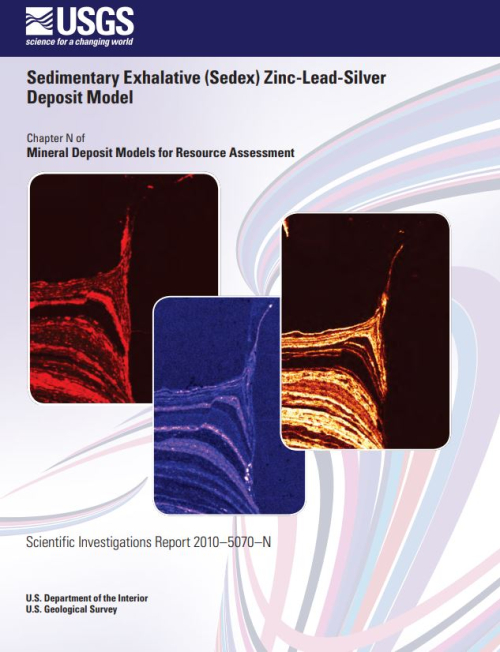
Sedimentary exhalative (sedex) deposits account for more than 50 percent of the world’s zinc (Zn) and lead (Pb) reserves (Tikkanen, 1986) and furnish more than 25 percent of the world’s current production of these two metals and a significant amount of silver (Ag) (Goodfellow and Lydon, 2007). More than 129 deposits of this type have been recognized in sedimentary basins around the world (Leach and others, 2005b; Goodfellow and Lydon, 2007). A compilation by Taylor and others (2009) shows that deposits occur in 25 sedimentary basins, 7 of which contain more than 10 million metric tons (Mt) of combined Pb+Zn (figs. 1, 2). In order of decreasing endowment, these basins are the Mt. IsaMcArthur basins, Australia (7 deposits containing 112 Mt of Zn+Pb metal); Selwyn basin, Canada (17 deposits, 55 Mt); Brooks Range, Alaska, United States (3 deposits, 40 Mt); Kholodninskoye deposit, Russia (1 deposit, 23 Mt); Rajasthan basin, India (5 deposits, 20 Mt); Belt-Purcell basin, United States and Canada (1 deposit, 19 Mt); and Rhenish basin, Germany (2 deposits, 11 Mt) (fig. 1). <...>
The Guaritas sequence is the uppermost stratigraphical level of the Camaqua Basin (southern Brazil) and comprises an alluvial, deltaic and aeolian continental facies association up to 800 m thick. Facies mapping of this unit has revealed a lateral association of tributary fans and trunk braided rivers developed under semi-arid conditions.
We substantially revised the first and second editions of this book while retaining our original objectives: to help you better understand (1) the processes that erode, transport, and deposit sediments (sedimentology); (2) the characteristics and origins of sedimentary rocks (sedimentary petrology); and (3) the complex distribution of the sedimentary rock record in space and time (stratigraphy). The first two areas are the subjects of Chapters 1 through 14. The field of stratigraphy is covered in Chapters 15 through 19.
This introductory manual to sedimentary geology was originally intended to accompany and complement J. Guillemot’s excellent book of basic geology (entitled Elements de geologie, fourth edition of 1986) used by generations of engineering students at the French Ecole du petrole et des moteurs.
Some 75% of the rocks at the Earth’s surface are sedimentary in origin, and these include the familiar sandstones, limestones and shales, and the less common but equally well-known salt deposits, ironstones, coal and chert. Sedimentary rocks of the geological record were deposited in the whole range of natural environments that exist today. The study of these modern environments and their sediments and processes contributes much to the understanding of their ancient equivalents. There are some sedimentary rock types; however, for which there are no known modern analogues, or their inferred depositional environments are only poorly represented at the present time.
LISP-UK studies BLACK, K. S. & PATERSON, D. M. LISP-UK Littoral Investigation of Sediment Properties: an introduction DYER, K. R. The typology of intertidal mudflats AMOS, C. L., BRYLINSKY, M., SUTHERLAND, T. F., O'BRIEN, D., LEE, S. & CRAMP, A. The stability of a mudflat in the Humber estuary, South Yorkshire, UK CHRISTIE, M. C. & DYER, K. R. Measurements of the turbid tidal edge over the Skeffling mudflats
LAW, D. J. & BALE, A. J. In situ characterization of suspended particles using focused-beam, laser reflectance particle sizing BROWN, S. L. Sedimentation on a Humber saltmarsh WIDDOWS, J., BRINSLEY, M. & ELLIOTT, M. Use of in situ flume to quantify particle flux (biodeposition rates and sediment erosion) for an intertidal mudflat in relation to changes in current velocity and benthic macrofauna
formations or indeed on any other process in which time played an integral and fundamental role. The advent of radionuclide dating, with the attendant absolute measure of age, changed the views of geology and processes that can occur in ways that have been of major significance. In addition, the radionuclides allow a direct comparison of absolute age to the prior proxies. Accordingly, not only had one available a true age dating but also a proxy scale that could be tie <...>
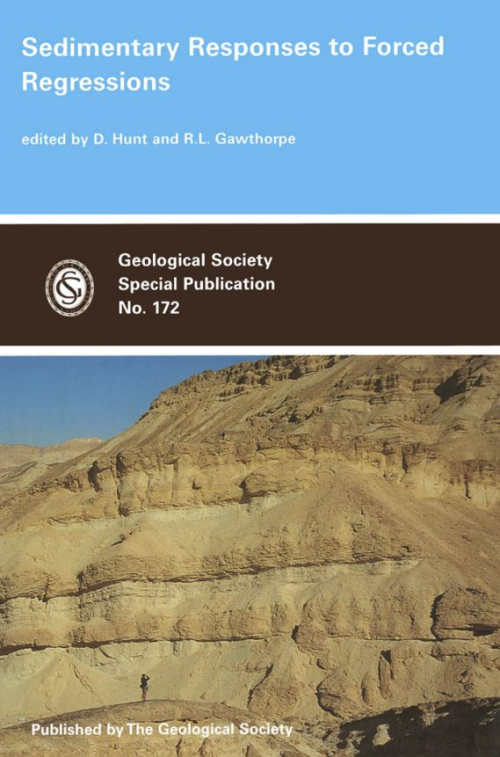
Concepts and Models FLINT, A. G. & NUMMEDAL, D. The falling stage systems tract: recognition and importance in sequence stratigraphic analysis POSAMENTIER, H. W. & MORRIS, W. R. Aspects of the stratal architecture of forced regressive deposits Palaeozoic-Mesozoic INESON, J. R. & SURLYK, F. Carbonate megabreccias in a sequence stratigraphic context: evidence from the Cambrian of North Greenland HAMBERG, L. & NIELSEN, L. H. Shingled, sharp-based sandstones: depositional response to stepwise forced regression in a shallow basin, Upper Triassic Gassum Formation, Denmark OLSEN, T. R. & STEEL, R. The significance of the Etive Formation in the development of the Brent system: a review of the likelihood of forced regression during progradation
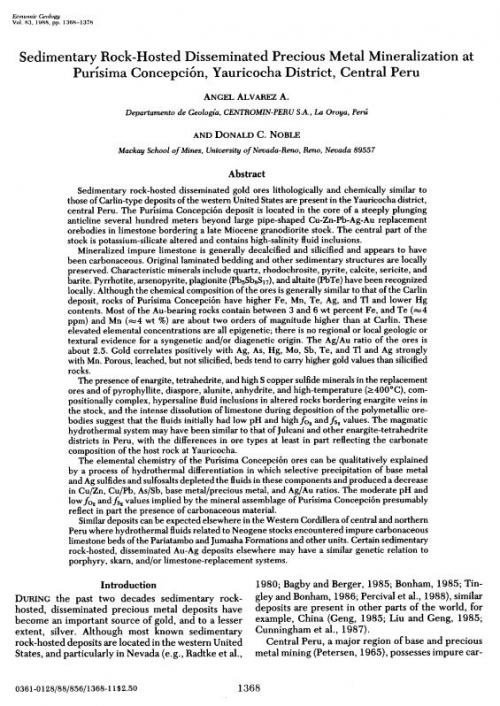
Sedimentary rock-hosted disseminated gold ores lithologically and chemically similar to those of Carlin-type deposits of the western United States are present in the Yauricocha district, central Peru. The Purisima Concepcion deposit is located in the core of a steeply plunging anticline several hundred meters beyond large pipe-shaped Cu-Zn-Pb-Ag-Au replacement orebodies in limestone bordering a late Miocene granodiorite stock. The central part of the stock is potassium-silicate altered and contains high-salinity fluid inclusions.
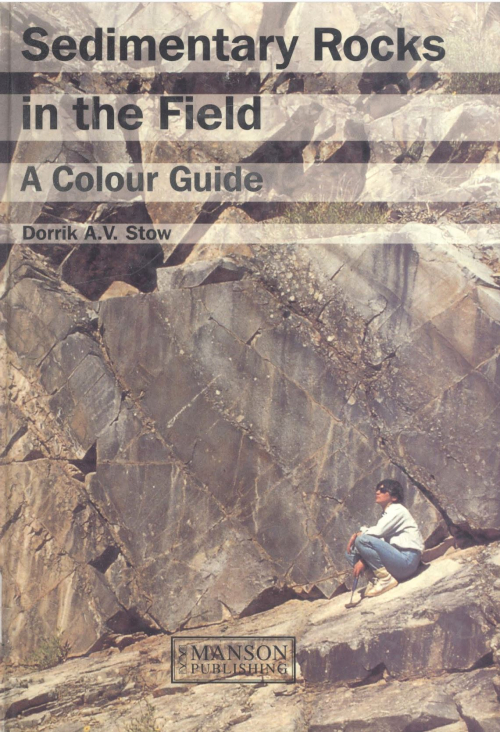
Sedimentary Rocks in the Field: A Colour Guide is a much needed addition to the literature of sedimentology. It offers much more than its title reveals. Eleven of the fifteen chapters define the main types of sedimentary rock and illustrate them in all their beauty and variety with numerous color photographs. The remaining chapters - also lavishly illustrated - provide introductions to field techniques, principal characteristics of sedimentary rocks, and interpretations of depositional environments, all of which enrich the book tremendously. The provision of stratigraphic time scales, mapping symbols, grain-size comparator chart and sediment description checklist, together with Wulff stereonet and Lambert equal-area projection templates, further adds to its usefulness in and out of the field.